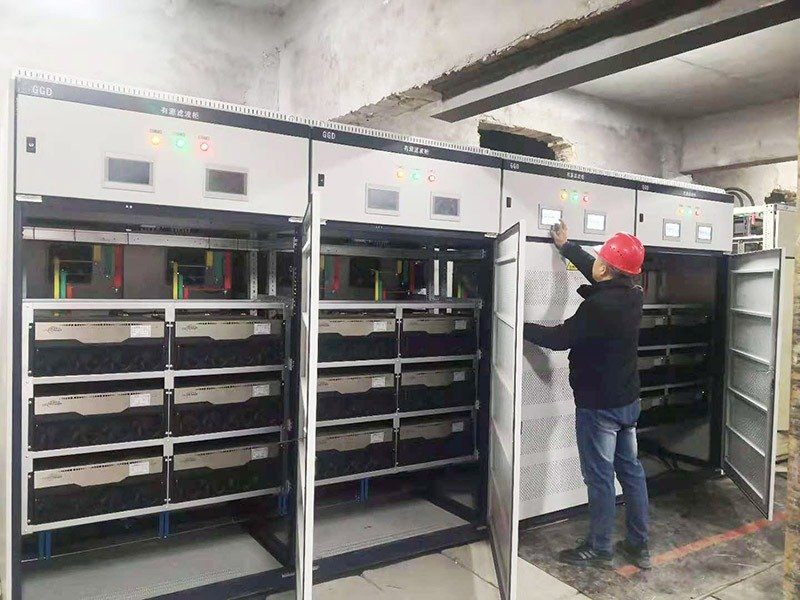
In today’s highly automated industrial environment, power quality has become a critical factor affecting productivity, equipment lifespan, and operational safety. As factories increasingly adopt variable frequency drives (VFDs), Gleichrichter, UPS -Systeme, Schweißmaschinen, and other nonlinear loads, harmonic distortion in electrical systems has grown significantly.
Als leitender Elektroingenieur bei CoEpower, I’ve seen firsthand how harmonics silently damage equipment, increase energy losses, and cause costly downtime. One of the most effective and intelligent solutions for modern industrial power systems is the AHF – Active Harmonic Filter.

In diesem Artikel, we’ll explore:
- What is an AHF (Aktiver harmonischer Filter)?
- Why harmonics are a serious industrial issue
- How AHF works
- Benefits of AHF for industrial power quality improvement
- Application scenarios
- Why choose CoEpower AHF solutions
What Is an AHF Active Harmonic Filter?
Ein aktiver harmonischer Filter (Ahf) is a power electronic device designed to dynamically detect and eliminate harmonic currents in real time. Unlike traditional passive filters, which rely on fixed LC tuning, an AHF uses advanced DSP control and IGBT-based inverter technology to inject compensating currents that cancel harmonic distortion.
In simple terms:
AHF monitors the distorted current → calculates harmonic components → injects reverse-phase harmonic currents → neutralizes distortion.
The result is a clean sinusoidal current waveform, significantly improving overall power quality.
Why Are Harmonics a Serious Industrial Problem?
Harmonics are generated by nonlinear loads such as:
- Variable Frequenzantriebe (VFDs)
- UPS -Systeme
- Softstarter
- Industrial welding machines
- LED -Beleuchtung
- Rectifiers
- Data center equipment
These devices draw non-sinusoidal currents from the grid, causing:
1. Transformer Overheating
Harmonic currents increase copper and iron losses, reducing transformer lifespan.
2. Cable and Busbar Overheating
RMS current increases due to harmonic content, leading to insulation degradation.
3. Capacitor Bank Failure
Harmonics may resonate with capacitor banks, causing overcurrent and explosions.
4. False Tripping of Breakers
Protective devices may trip due to waveform distortion and peak current increase.
5. Reduced Equipment Efficiency
Motors and sensitive electronics operate less efficiently under distorted voltage conditions.
6. High Utility Penalties
Many utilities impose penalties when Total Harmonic Distortion (Thd) exceeds standards such as IEEE 519.
Without proper mitigation, harmonic distortion directly translates into financial losses.
How Does an Active Harmonic Filter Work?
The operation of AHF can be broken into four key steps:
1. Echtzeiterkennung
Current transformers (CTs) monitor load current and send signals to the controller.
2. Harmonische Analyse
Using Fast Fourier Transform (Fft) algorithms, the DSP identifies harmonic orders (5th, 7th, 11th, 13th, usw.).
3. Compensation Current Calculation
The system calculates the required compensating current.
4. Reverse Current Injection
IGBT inverter injects equal amplitude but opposite-phase harmonic currents into the system.
This results in:
- Reduced Total Harmonic Distortion (Thdi)
- Verbesserter Leistungsfaktor
- Balanced three-phase currents
- Reduced neutral current
All of this happens in milliseconds.
AHF vs Passive Harmonic Filter
| Besonderheit | Passive Filter | Aktiver harmonischer Filter |
|---|---|---|
| Tuning | Fixed frequency | Dynamic & real-time |
| Anpassungsfähigkeit | Poor | Exzellent |
| Risk of Resonance | Ja | NEIN |
| Multiple Harmonic Orders | Beschränkt | Multiple simultaneously |
| Installationsflexibilität | Niedrig | Hoch |
| Reaktionsgeschwindigkeit | Slow | Schnell |
Passive filters may work in stable systems, but modern industrial environments require dynamic and adaptive solutions. That is where AHF becomes the superior choice.
Key Benefits of AHF for Industrial Power Quality Improvement
1. Significant THD Reduction
AHF can reduce THDi to below 5%, meeting IEEE 519 Standards.
2. Verbesserter Leistungsfaktor
By compensating reactive power, AHF increases system efficiency and reduces penalties.
3. Energy Savings
Lower losses in transformers and cables translate to measurable energy savings.
4. Extended Equipment Lifespan
Reduced thermal stress means longer operational life.
5. Prevention of Production Downtime
Stable power reduces unexpected shutdowns.
6. Modulares Design
Most modern AHFs are modular, allowing flexible expansion.
7. Intelligent Monitoring
Advanced AHFs support:
- RS485 / Modbus communication
- Remote monitoring
- Real-time waveform display
- Fault diagnostics
Typical Applications of Active Harmonic Filters
AHF is widely used in:
- Fertigungsanlagen
CNC -Maschinen, VFD-gesteuerte Motoren, robotic lines.
- Rechenzentren
Large UPS systems generating high harmonic content.
- Handelsgebäude
HVAC systems and LED lighting loads.
- Öl & Gasindustrie
Drilling equipment and heavy-duty motor drives.
- Mining Operations
High-power converters and crushers.
- Erneuerbare Energiesysteme
Solar inverters and wind converters.
Wherever nonlinear loads exist, AHF provides value.
How to Select the Right AHF?
When choosing an Active Harmonic Filter, halten:
- System Voltage (380V, 400V, 480V, 690V)
- Nennstrom
- THDi level before compensation
- Target THDi after compensation
- Lastvariabilität
- Installation space
- Future expansion requirements
A professional harmonic analysis should be conducted before sizing the equipment.
Why Choose Coepower AHF Solutions?
Bei CoEpower, we design industrial-grade Active Harmonic Filters with:
- High-efficiency IGBT modules
- Advanced DSP control algorithms
- Modulare Struktur (50A / 75A / 100A per module)
- Intelligent monitoring interface
- High reliability in harsh industrial environments
- Compliance with international standards
Our engineering team provides:
- On-site harmonic testing
- Customized solution design
- Installation guidance
- After-sales technical support
We don’t just supply equipment — we deliver complete power quality solutions.
Future Trend: Intelligent Power Quality Management
As Industry 4.0 continues to expand, factories are becoming more electrified and digitized. The demand for stable and clean power will only increase.
Active Harmonic Filters are evolving toward:
- AI-based adaptive compensation
- Cloud monitoring integration
- Energy management system (EMS) compatibility
- Compact high-density power design
AHF is no longer optional in large industrial systems — it is becoming a standard configuration.
Harmonic distortion is a hidden but serious threat to industrial power systems. Left unmanaged, it leads to overheating, inefficiency, downtime, and financial penalties.
Ein aktiver harmonischer Filter (Ahf) offers a dynamic, reliable, and future-proof solution for industrial power quality improvement.
By implementing CoEpower AHF solutions, industrial facilities can:
- Reduce THD
- Improve power factor
- Enhance system reliability
- Lower operational costs
- Ensure compliance with international standards
If your facility uses VFDs, UPS -Systeme, or other nonlinear loads, now is the time to evaluate your harmonic levels and invest in a smarter solution.
Clean power means stable production. And stable production means sustainable growth.
Tags: AHF Active Harmonic Filter, Industrial Power Quality Improvement, Harmonic Filter for Factory, Reduce THD, IEEE 519 Harmonische Konformität, Harmonic Mitigation Solution, Power Quality Equipment, Harmonic Compensation System, Industrial Electrical Harmonics, Lieferanten, Hersteller, Fabrik, Großhandel, kaufen, Preis, Zitat, Schüttgut, zu verkaufen, Unternehmen, Aktie, kosten.
Verwandte Produkt
Holen Sie sich noch heute ein Angebot ein