
Before requesting an active harmonic filter assessment, collect the site’s electrical configuration, the loads operating when the problem occurs, and any power-quality measurements already available.A one-line diagram and clear photos of relevant nameplates can add useful context. These items are a preparation checklist, not a universal set of mandatory prerequisites: if a value or measurement is unavailable, mark it as unknown rather than estimating it.
An AHF assessment should begin with the electrical problem and the conditions in which it appears. The information below can help an engineering review distinguish observed symptoms from measured harmonic behavior and determine what further investigation may be needed. It does not establish that an AHF is the right solution for every power-quality issue.
ในคู่มือนี้
- Why Preparation Matters Before an AHF Assessment
- Basic Site and Electrical System Information
- Transformer and Distribution System Details
- Load Types and Operating Conditions
- Harmonic Measurement Data
- Existing Power Quality Problems
- Photos, Drawings and Electrical Documents
- What If You Do Not Have All the Measurement Data?
- How to Request an AHF Assessment
- Final Checklist: Are You Ready to Request an AHF Assessment?
- คำถามที่พบบ่อย
Why Preparation Matters Before an Active Harmonic Filter Assessment
Harmonic measurements depend on where and when they are taken, what equipment is operating, and how the facility is connected. A current spectrum from one panel during one production state may not describe the conditions at another point or during a different load combination.
The point of common coupling (PCC) also matters when discussing system-level harmonic limits. IEEE 519-2022 describes steady-state voltage and current distortion goals in the context of the PCC; it is not a universal intake form for AHF quotations or a substitute for understanding a particular installation.
A useful request therefore separates three things:
- What you observed: ตัวอย่างเช่น, a drive alarm or a recurring process interruption.
- What you measured: including instrument, location, time, and operating state where known.
- What you suspect: a possible cause that still needs investigation.
Keeping those categories separate helps avoid treating a symptom as a confirmed diagnosis.
Basic Site and Electrical System Information
Start with basic context. Provide what you know; do not delay a first inquiry solely because every field is not available.
| Record | What to include | Priority |
| Site and process | Country/region, facility type, and the process or area affected; omit sensitive customer identifiers if unnecessary | Helpful |
| Supply basics | Nominal voltage, phase arrangement, และ 50/60 Hz frequency if known | Recommended |
| Affected location | อาคาร, line, switchboard, or equipment group where the issue occurs | Recommended |
| Issue timing | When it started, how often it occurs, and whether it is continuous, shift-related, or intermittent | Recommended |
| Operating schedule | Typical production shifts and major changes in operating state | Helpful |
| Utility or internal observations | Any utility notice, alarm record, or previous power-quality report relevant to the issue | Optional, ถ้ามี |
If the supply arrangement or nominal values are uncertain, say so. A clear statement such as “not confirmed” is more useful than an assumed value.
Transformer and Distribution System Details
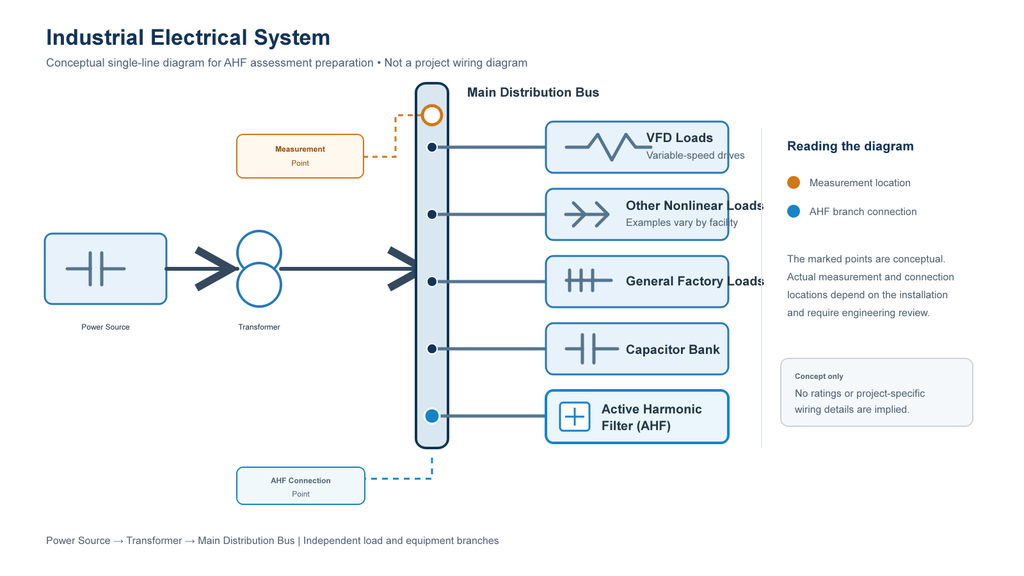
If available, include the transformer nameplate and a current single-line diagram. These help identify the electrical path between the supply, the affected loads, and any proposed measurement or equipment location.
Useful details may include:
- Transformer rated capacity and primary/secondary voltage;
- Impedance, connection, and grounding information if legible and available;
- The board, bus, feeder, or circuit serving the affected equipment;
- The location of existing capacitor banks, ตัวกรอง, or power-factor correction equipment;
- Relevant upstream or downstream transformers and parallel sources; และ
- The known or estimated PCC location, if the facility has identified it.
These are supporting details, not a requirement to create a new engineering drawing before making contact. An existing diagram with the affected section marked is often a practical starting point. Redact site-sensitive labels or customer information if needed and permitted by your organization.
Load Types and Operating Conditions
List the equipment that was operating when the issue appeared. Depending on the facility, this might include variable-frequency drives, เครื่องตัดกัน, ระบบ UPS, อุปกรณ์เชื่อม, switched-mode power supplies, or other power-electronic loads. These are examples only; their presence does not by itself prove that harmonics are causing a problem.
For each relevant load group, record what is known:
- Equipment type and approximate quantity;
- Nameplate rating or operating power, ถ้ามี;
- Whether the load is usually on, cycles on and off, or varies with production;
- Which loads were operating during a measurement or event; และ
- Recent changes such as new drives, สายการผลิต, or capacitor equipment.
If exact ratings are not available, a labelled equipment list or a photo of the relevant nameplates may still provide context. Do not infer total demand or harmonic contribution from equipment labels alone.
Harmonic Measurement Data
If measurements have already been taken, share the original report or exported data to support an active harmonic filter assessment. Include the context needed to interpret the measurements. Do not treat a single metric as a complete diagnosis.
| Measurement context | Record if available |
| จุดวัด | PCC, main incomer, distribution board, or load feeder; identify the location precisely |
| Instrument | Manufacturer/model and measurement mode or category shown in the report |
| Quantity | แรงดันไฟฟ้า, ปัจจุบัน, หรือทั้งสองอย่าง; identify phase or conductor where the report does so |
| Time and duration | Start/end time, date, logging interval, and whether the record covers a representative operating period |
| Operating state | Production condition and major loads running during the measurement |
| Harmonic results | Individual harmonic spectrum/order and reported voltage/current THD or TDD, including the report’s definitions and reference values |
| Variation | Minimum/maximum or trend plots, if the instrument recorded them |
| File | Original instrument export or complete report, rather than only a cropped screenshot |
Measurement methods and instruments matter. IEC 61000-4-7 is a guide to harmonic and interharmonic measurement instrumentation; the available preview describes scope for spectral components up to 9 kHz on 50 Hz and 60 Hz power systems. Confirm the applicable edition and measurement requirements for the specific project before treating any procedure as normative.
Avoid comparing readings from different locations or operating states as if they were directly equivalent. Likewise, do not label a site “compliant” or “non-compliant” from an isolated panel reading without confirming the applicable measurement point, metric, time basis, and governing requirements.
Existing Power Quality Problems
Describe what people or equipment actually experienced. A short event log can be more informative than a broad conclusion such as “the power is unstable.”
| Event or symptom | What to note |
| Trips, สัญญาณเตือน, or resets | Equipment affected, exact alarm if available, date/time, and whether the event repeated |
| Process interruption | What stopped or was disrupted and for how long, if known |
| Heat, noise, or nuisance operation | Which equipment, when noticed, and whether it coincided with a specific operating condition |
| Measured abnormality | Instrument, metric, location, time, and report reference; separate this from an unmeasured suspicion |
| Previous actions | Changes already tried and what happened afterward |
Do not assume every trip, overheating event, or interruption is caused by harmonics. แรงดันไฟฟ้าตก, switching events, unbalance, wiring issues, equipment faults, and other conditions may need to be considered by a qualified engineer.
Photos, Drawings and Electrical Documents
Where safe and allowed by site procedures, useful existing records can include:
- A single-line diagram or marked-up section of the distribution system;
- Transformer and relevant equipment nameplates;
- The labels of existing filters or capacitor banks;
- The power-quality analyzer report and its setup details; และ
- Alarm logs or a dated symptom record.
Do not open energized equipment or take photographs in a way that conflicts with site electrical-safety procedures. Use existing approved images or have authorized site personnel provide documentation. Remove or redact information your organization considers confidential before sharing it.
What If You Do Not Have All the Measurement Data?
You can still organize an initial inquiry around what is known. Use this tiered checklist:
| ระดับ | ข้อมูล |
| Useful starting context | Facility/process area, affected equipment, observed issue, when it occurs, and a contact who understands the electrical system |
| Recommended technical context | Nominal supply details, transformer/distribution information, load types and operating state, and an existing single-line diagram |
| Additional evidence if available | Harmonic measurement report/export, event logs, equipment nameplates, and details of previous corrective actions |
Mark missing values as “unknown” or “not measured.” Do not create estimates that look like readings, and do not assume a particular measurement duration or instrument is universally required. An engineer can identify what further information is needed once the system and issue are understood.
How to Request an Active Harmonic Filter Assessment
When preparing to request an active harmonic filter assessment, check that files are labelled with the site area, จุดวัด, date, and operating condition where possible. A compact request can state:
- What problem you observed and which equipment is affected;
- When it occurs and what loads were operating;
- What system details and measurements you have; และ
- Which important information is still unknown.
For CoEpower product context, see the active harmonic filter product page and its AHF application/solution overview. To discuss your site information, ใช้ CoEpower’s contact page and ask whether the company can review your case and what materials it needs.
Final Checklist: Are You Ready to Request an AHF Assessment?
Before contacting an engineering team, check whether you have prepared the following information:
☐ Basic site information, including the affected area, อุปกรณ์, and issue timing.
☐ Electrical supply details, including voltage, phase arrangement, and frequency.
☐ Transformer nameplate information and an available single-line diagram.
☐ Main distribution details, including relevant buses, feeders, and existing power quality equipment.
☐ Major load types, approximate quantities, and operating conditions.
☐ Available harmonic measurement reports, including measurement points, dates, and operating states.
☐ Records of observed problems, such as equipment trips, สัญญาณเตือน, ความร้อนสูงเกินไป, or process interruptions.
☐ Photos of relevant equipment nameplates, existing filters, and capacitor banks, ถ้ามี.
☐ Previous inspection records, corrective actions, or other relevant technical documents.
☐ Available site information, including installation conditions and any known environmental or access constraints, if an AHF installation is being considered.
You do not need to prepare every item before making an initial inquiry. The checklist is intended to help organize the information already available and identify what may still need to be investigated.
คำถามที่พบบ่อย
What information is needed for an active harmonic filter assessment?
Start with your electrical system details, including nominal voltage, ความถี่, phase configuration, transformer information, and an available single-line diagram. Information about major loads, operating conditions, and the power quality problem is also useful. Existing harmonic measurement reports can provide additional context.
Do I need a harmonic measurement report before requesting an AHF assessment?
เลขที่. You can make an initial inquiry with the site and electrical information already available. If no harmonic measurements have been conducted, simply explain which information is missing. Further measurement requirements can be discussed based on the application.
Why does an engineer need to know which loads were operating during a measurement?
Harmonic conditions can change depending on which equipment is running and the facility’s operating state. Recording the major loads and production conditions helps engineers understand whether the available measurements represent normal or relevant operating conditions.
Why should I provide a single-line diagram?
A single-line diagram helps show how the electrical system is arranged, including transformers, distribution boards, feeders, and major loads. It provides useful context for understanding the affected area and identifying relevant measurement or equipment locations.
Should I include information about existing capacitor banks and power quality equipment?
ใช่. Existing capacitor banks, ตัวกรอง, reactors, AHF units, and other power quality equipment may affect the electrical conditions of the installation. Providing their locations and available operating information helps engineers understand the existing system.
What should I do if some site information is unavailable?
Do not estimate values or create measurements that have not been taken. Mark unavailable information as “unknown” หรือ “not measured” and provide the records you already have. An initial discussion can help identify which additional information may be needed.
Need Help with Your AHF Application?
Every electrical installation has different operating conditions and power quality requirements. Having your site information and available measurement records ready can help make the initial technical discussion more productive.
If you are considering an Active Harmonic Filter for your facility, contact CoEpower to discuss your application and share your requirements.