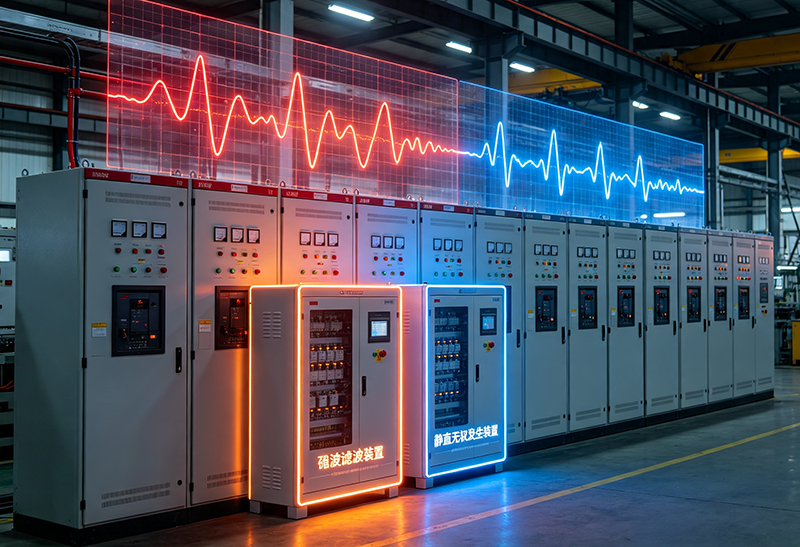
In modern industrial and commercial power systems, harmonic distortion, reactive power issues, and unbalanced loads are becoming increasingly common due to the widespread use of non-linear equipment such as VFDs, UPS systems, EV chargers, data centers, and renewable energy inverters.
An Active Power Filter (APF) is one of the most effective solutions for improving power quality. However, selecting the wrong APF can result in underperformance, system instability, wasted investment, or even equipment failure.

As a senior electrical engineer at CoEpower, I’ve seen many projects where improper selection led to avoidable complications. In this article, we’ll explore the most common mistakes in active power filter selection and how to avoid them.
What Is an Active Power Filter?
An Active Power Filter is a power electronic device designed to:
- Eliminate harmonic currents
- Compensate reactive power
- Improve power factor
- Balance three-phase currents
- Reduce neutral current
- Stabilize system voltage
Unlike traditional passive filters, APFs dynamically detect and inject counteracting currents in real time.
Common Mistakes in Active Power Filter Selection
- Selecting APF Capacity Based Only on Transformer Size
❌ The Mistake:
Many engineers calculate APF capacity based on transformer rated capacity (kVA) instead of actual harmonic load current.
⚠ Why It’s Wrong:
Harmonics are generated by non-linear loads, not by the transformer itself. Transformer capacity does not reflect harmonic current levels.
For example:
1000 kVA transformer
But only 300 kW nonlinear loads
If harmonic current is 200A, installing a 400A APF based solely on transformer size is excessive and costly.
✅ How to Avoid:
Always conduct:
- Harmonic measurement (using power quality analyzer)
- Total Harmonic Distortion (THDi) assessment
- Load current harmonic spectrum analysis
APF rating should be based on measured harmonic current, not transformer capacity.
2. Ignoring Harmonic Spectrum Analysis
❌ The Mistake:
Choosing APF without understanding dominant harmonic orders (5th, 7th, 11th, 13th, etc.)
⚠ Why It’s Dangerous:
Different industries generate different harmonic patterns:
- VFD systems → 5th & 7th harmonics
- Data centers → 3rd harmonic dominant
- EV chargers → high-frequency harmonics
Without spectrum analysis:
- APF may be undersized
- Response bandwidth may be insufficient
- Compensation efficiency decreases
✅ How to Avoid:
Use a power analyzer to identify:
- Harmonic order distribution
- Maximum harmonic current per phase
- Neutral harmonic levels
Select APF with:
Sufficient dynamic response time (<10ms recommended)
Full harmonic compensation capability (2nd–50th order)
3. Overlooking System Voltage Level and Installation Location
❌ The Mistake:
Installing APF at the wrong point in the distribution system.
⚠ Common Errors:
- Installing at transformer secondary when harmonics originate from branch loads
- Central compensation when distributed compensation is required
✅ How to Avoid:
Consider:
- Main distribution board vs. branch circuit installation
- Centralized vs. decentralized APF strategy
- Space and ventilation conditions
In large industrial systems, decentralized APF placement near harmonic sources is often more efficient.
4. Focusing Only on Harmonic Filtering and Ignoring Reactive Power Compensation
❌ The Mistake:
Selecting APF only for harmonic suppression without considering power factor correction.
Modern APFs can provide both:
- Harmonic compensation
- Reactive power compensation
⚠ Consequences:
- Poor power factor
- Utility penalties
- Increased line losses
✅ How to Avoid:
Choose multifunctional APF that supports:
- Harmonic mitigation
- Dynamic reactive power compensation
- Three-phase imbalance correction
This reduces the need for separate capacitor banks.
5. Ignoring Future Load Expansion
❌ The Mistake:
Sizing APF only for current load conditions.
⚠ Real-World Issue:
Factories often expand:
- Additional production lines
- More VFD drives
- Increased automation
APF becomes undersized within 1–2 years.
✅ How to Avoid:
Design with:
- 20–30% capacity margin
- Modular APF system for scalability
- Modular active power filters allow easy parallel expansion.
6. Not Considering THDv (Voltage Harmonics)
Many engineers focus only on THDi (current distortion) and ignore THDv.
⚠ Why This Matters:
If system impedance is high, harmonic currents can cause excessive voltage distortion.
High THDv can:
Damage sensitive equipment
Cause PLC malfunction
Reduce motor life
✅ Solution:
Measure both:
THDi
THDv
Ensure APF selection considers system short-circuit capacity and impedance.
7. Choosing Low-Quality or Non-Certified APF
❌ The Mistake:
Selecting APF purely based on lowest price.
⚠ Risks:
- Unstable DSP control
- Slow response time
- Poor compensation accuracy
- Overheating
- High failure rate
✅ What to Look For:
- IGBT-based topology
- Real-time DSP control
- CE / IEC compliance
- High switching frequency
- Reliable thermal management
Power quality equipment is long-term infrastructure — reliability matters more than initial cost.
8. Ignoring Cooling and Environmental Conditions
❌ The Mistake:
Installing APF in poorly ventilated electrical rooms.
⚠ Result:
- Thermal derating
- Reduced lifespan
- Unexpected shutdown
✅ Best Practice:
Ensure:
- Adequate airflow
- Ambient temperature < 40°C
- Dust protection (IP rating consideration)
Industrial APFs must be selected according to installation environment.
9. Misunderstanding Neutral Current Compensation
In systems with large single-phase loads (e.g., data centers, office buildings):
Third harmonics accumulate in neutral conductors.
⚠ Problem:
Neutral current can exceed phase current.
✅ Solution:
Select APF with:
3P4W topology
Neutral current compensation capability
10. Failing to Perform Site Power Quality Audit
The biggest mistake of all is skipping detailed measurement.
Without:
- 7-day power quality logging
- Load variation analysis
- Peak harmonic recording
Selection becomes guesswork.
Professional APF selection must be data-driven.
Step-by-Step Guide to Correct APF Selection
- Conduct on-site power quality analysis
- Measure THDi, THDv, harmonic spectrum
- Calculate maximum harmonic current
- Determine installation location
- Consider reactive power demand
- Include future expansion margin
- Select modular & certified equipment
- Verify cooling and environment
Why Proper Active Power Filter Selection Matters
Correct APF selection ensures:
- Reduced harmonic distortion
- Improved power factor
- Lower energy losses
- Compliance with IEEE 519 standards
- Extended equipment lifespan
- Reduced downtime
- Improved system reliability
Incorrect selection leads to:
- Persistent harmonic problems
- Wasted investment
- Overheating cables
- Utility penalties
Active Power Filters are powerful solutions for harmonic mitigation and power quality improvement — but only when selected correctly.
At CoEpower, we recommend a data-driven approach combining:
- Professional harmonic measurement
- Engineering calculation
- Modular scalable design
- High-reliability hardware
Avoiding these common mistakes will ensure long-term system stability, regulatory compliance, and return on investment.
If you are planning a power quality improvement project, proper APF selection is not optional — it is essential.
Tags: Active Power Filter, APF selection, harmonic mitigation, power quality improvement, harmonic distortion solution, THDi reduction, THDv control, reactive power compensation, power factor correction, IEEE 519 compliance, industrial power quality, modular active power filter, harmonic current analysis, three-phase imbalance correction, neutral current compensation, Suppliers, manufacturers, factory, wholesale, buy, price, quotation, bulk, for sale, companies, stock, cost.