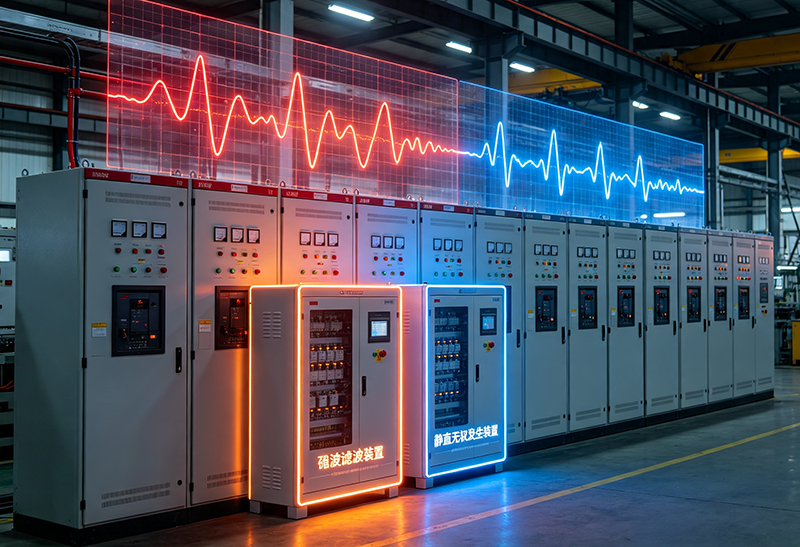
As industrial facilities become increasingly dependent on power electronic equipment, harmonic distortion has become one of the most common power quality challenges facing engineers today. Variable frequency drives (VFDs), rectifiers, UPS systems, induction furnaces, EV chargers, and renewable energy inverters all introduce harmonics into electrical systems.
Excessive harmonics can lead to overheating transformers, capacitor failures, nuisance tripping, reduced equipment lifespan, and utility compliance issues. As a result, selecting the right harmonic mitigation solution is essential for maintaining system reliability and energy efficiency.
Among the most widely used solutions are three-phase harmonic filters and active harmonic filters (APF). While both technologies are designed to reduce harmonic distortion, their operating principles, performance characteristics, and application scenarios differ significantly.
As a senior electrical engineer at CoEpower, I am often asked by facility managers and consulting engineers:
“Should I install a traditional three-phase harmonic filter or an active harmonic filter?”
In this article, I will explain the differences between these two technologies and help you determine which solution is best suited for your facility.
Understanding Harmonics in Industrial Power Systems
Before comparing filter technologies, it is important to understand what harmonics are.
In an ideal electrical system, voltage and current waveforms are pure sine waves operating at 50 Hz or 60 Hz.
However, nonlinear loads draw current in pulses rather than smooth sinusoidal patterns. This creates additional frequency components known as harmonics.
Common harmonic orders include:
- 3rd harmonic (150 Hz)
- 5th harmonic (250 Hz)
- 7th harmonic (350 Hz)
- 11th harmonic (550 Hz)
- 13th harmonic (650 Hz)
The more nonlinear equipment installed in a facility, the greater the harmonic distortion.
Typical consequences include:
- Transformer overheating
- Increased cable losses
- Capacitor bank failures
- Motor vibration
- Power factor deterioration
- Production downtime
- Failure to meet IEEE 519 requirements
This is where harmonic filters become essential.
What Is a Three-Phase Harmonic Filter?
A three-phase harmonic filter, commonly known as a passive harmonic filter, is a filtering device composed of inductors, capacitors, and sometimes resistors.
It is designed to create a low-impedance path for specific harmonic frequencies, diverting harmonic currents away from the power system.
How It Works
Passive filters are tuned to target predetermined harmonic frequencies.
For example:
- 5th harmonic filter
- 7th harmonic filter
- 11th harmonic filter
When harmonic currents at these frequencies are present, they flow into the filter rather than the distribution network.
The result is reduced harmonic distortion throughout the system.
Advantages of Three-Phase Harmonic Filters
Lower Initial Cost
Passive filters generally cost less than active harmonic filters for the same current rating.
This makes them attractive for projects with limited budgets.
Simple Construction
The technology has been used for decades and consists primarily of passive electrical components.
No sophisticated control algorithms are required.
High Capacity Applications
Passive filters can be designed for very large industrial loads where harmonic frequencies remain predictable.
Reactive Power Compensation
Many passive filters provide harmonic mitigation and power factor correction simultaneously.
Limitations of Three-Phase Harmonic Filters
Despite their advantages, passive filters have several drawbacks.
Fixed Compensation
Passive filters only target harmonics for which they are specifically designed.
If load characteristics change, filter effectiveness may decline.
Resonance Risk
One of the most significant concerns is harmonic resonance.
Improperly designed passive filters can resonate with the utility network, actually amplifying harmonics rather than reducing them.
Reduced Flexibility
Industrial facilities often expand production or install new equipment.
A passive filter designed today may not adequately address future harmonic conditions.
Limited Harmonic Coverage
Most passive filters target only specific harmonic orders.
Higher-order harmonics may remain untreated.
What Is an Active Harmonic Filter (APF)?
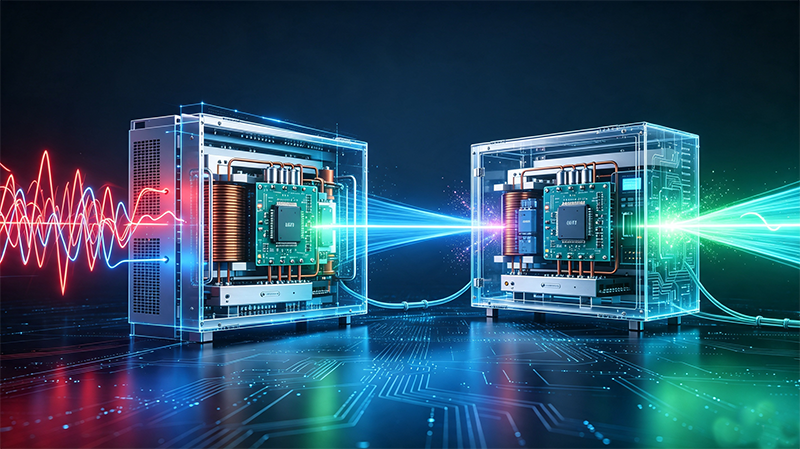
An Active Harmonic Filter is an advanced power electronics device that dynamically measures harmonic currents and injects equal and opposite compensation currents into the system.
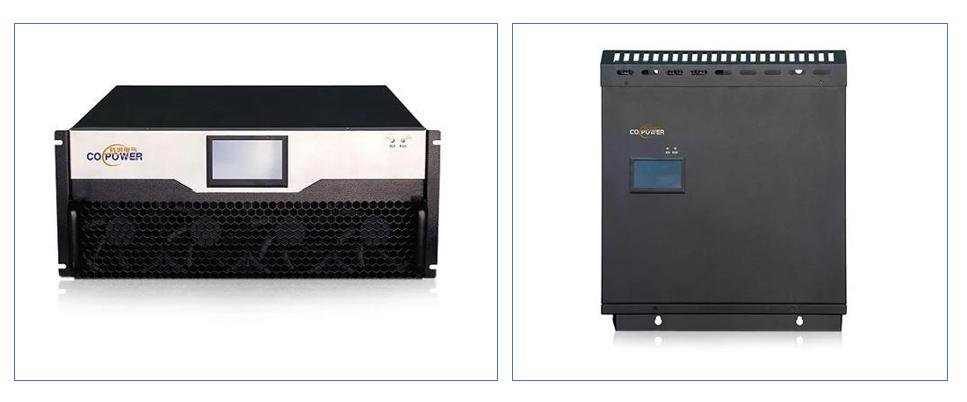
Instead of absorbing harmonics like passive filters, APFs actively cancel them.
This technology is widely considered the most advanced solution for harmonic mitigation in modern industrial power systems.
How Active Harmonic Filters Work
The APF continuously monitors current waveforms using high-speed digital signal processors (DSPs).
The system:
- Detects harmonic components
- Calculates compensation requirements
- Generates inverse harmonic currents
- Injects compensation currents into the network
The unwanted harmonics are effectively cancelled in real time.
The process occurs within milliseconds.
As load conditions change, the APF automatically adjusts its compensation strategy.
Advantages of Active Harmonic Filters
Dynamic Harmonic Compensation
Unlike passive filters, APFs adapt instantly to changing load conditions.
This makes them ideal for facilities with variable production schedules.
Broad Harmonic Coverage
A single APF can simultaneously compensate:
- 2nd to 50th harmonics
- Odd harmonics
- Even harmonics
- Interharmonics
No tuning is required.
No Resonance Risk
Because APFs do not rely on LC resonance circuits, they eliminate the risk of harmonic amplification.
This significantly improves system reliability.
Reactive Power Compensation
Modern APFs can provide:
- Harmonic filtering
- Reactive power compensation
- Power factor correction
- Load balancing
All within a single device.
Compliance with IEEE 519
Many facilities use APFs to achieve compliance with IEEE 519 harmonic standards and utility requirements.
Limitations of Active Harmonic Filters
Higher Initial Investment
APFs typically require a larger upfront investment than passive filters.
However, lifecycle costs are often lower due to improved efficiency and flexibility.
Electronic Components
As power electronic devices, APFs contain IGBTs, controllers, and cooling systems that require proper maintenance.
Capacity Planning
Extremely large harmonic loads may require multiple APF units operating in parallel.
Side-by-Side Comparison
| Feature | Three-Phase Harmonic Filter | Active Harmonic Filter |
| Technology | Passive LC Network | Power Electronics |
| Harmonic Coverage | Selected Harmonics | Broad Spectrum |
| Dynamic Compensation | No | Yes |
| Load Adaptability | Limited | Excellent |
| Resonance Risk | Yes | No |
| Reactive Power Compensation | Possible | Yes |
| Future Expansion Compatibility | Limited | High |
| Maintenance | Low | Moderate |
| Initial Cost | Lower | Higher |
| Long-Term Flexibility | Low | Excellent |
| IEEE 519 Compliance | Moderate | Excellent |
Which Industries Prefer Passive Harmonic Filters?
Passive harmonic filters are commonly used in:
- Cement plants
- Steel mills
- Mining facilities
- Water treatment plants
- Large motor applications
These environments often have relatively stable load profiles where harmonic characteristics remain predictable.
Which Industries Prefer Active Harmonic Filters?
At CoEpower, we frequently recommend APFs for:
- Semiconductor manufacturing
- Data centers
- Commercial buildings
- Hospitals
- EV charging stations
- Solar power plants
- Battery energy storage systems (BESS)
- Electronics manufacturing
- Monocrystalline silicon production
These applications typically involve rapidly changing nonlinear loads that require dynamic compensation.
Cost vs Performance: The Real Decision
Many buyers focus solely on equipment price.
However, experienced engineers evaluate:
- Energy losses
- Production downtime risk
- Maintenance costs
- Expansion requirements
- Utility penalties
- Equipment lifespan
While passive filters may have lower upfront costs, APFs often deliver greater long-term value due to their flexibility and superior performance.
For facilities planning future expansion or operating highly variable loads, active harmonic filters are usually the more economical choice over the equipment lifecycle.
CoEpower’s Recommendation
After implementing harmonic mitigation projects across manufacturing, renewable energy, and commercial sectors, our engineering team has observed a clear trend.
For modern industrial facilities with variable nonlinear loads, Active Harmonic Filters provide the highest level of power quality improvement, operational flexibility, and future-proofing.
Passive harmonic filters remain a viable solution for stable load environments and budget-sensitive projects. However, for facilities aiming to achieve stringent harmonic standards, maximize equipment reliability, and support future growth, APFs are often the preferred technology.
Conclusion
Both three-phase harmonic filters and active harmonic filters play important roles in harmonic mitigation. The best solution depends on your facility’s load profile, harmonic levels, expansion plans, and power quality objectives.
Choose a three-phase harmonic filter if:
- Harmonic sources are predictable
- Load conditions are stable
- Budget is a primary concern
Choose an Active Harmonic Filter (APF) if:
- Harmonic conditions change frequently
- High filtering performance is required
- IEEE 519 compliance is important
- Future system expansion is expected
At CoEpower, we help customers analyze power quality data and select the most cost-effective harmonic mitigation solution based on real operating conditions.
If your facility is experiencing excessive THD, capacitor failures, transformer overheating, or poor power factor, our engineering team can provide a customized harmonic analysis and filtering solution tailored to your needs.
Tags:
Three-Phase Harmonic Filter, Active Harmonic Filter, APF, Harmonic Mitigation, Harmonic Filter vs APF, Industrial Harmonics, Power Quality Solutions, Passive Harmonic Filter, Active Power Filter, Power Factor Correction, Harmonic Distortion Reduction, Electrical Harmonic Filtering, Industrial Power Quality, CoEpower APF, IEEE 519 Compliance, suppliers, manufacturers, factory, company, China, wholesale, buy, price, quotation, bulk, for sale, companies, stock, cost.