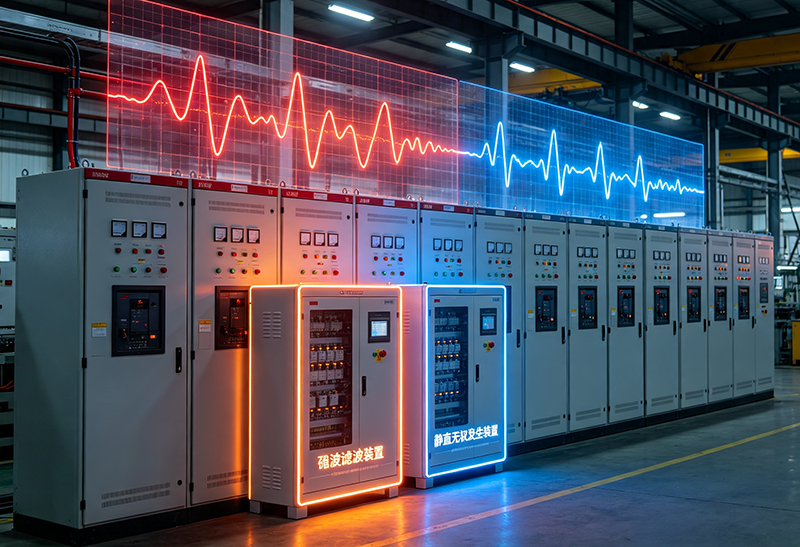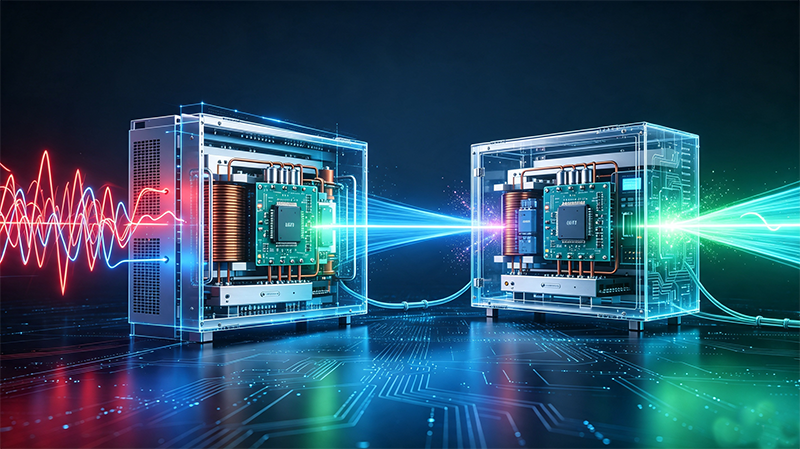
In today’s industrial and commercial power systems, harmonic distortion has become a growing challenge. As more facilities rely on non-linear electrical loads such as variable frequency drives (VFDs), UPS systems, LED lighting, EV chargers, welding machines, and data center equipment, the issue of harmonics can no longer be ignored.
At CoEpower, we frequently help engineers, EPC contractors, and facility managers solve power quality problems caused by harmonics. Two of the most commonly discussed solutions are single-phase harmonic filters and active harmonic filters (AHFs).
Although both technologies are designed to reduce harmonic distortion, they differ significantly in design principles, application scenarios, performance, and cost. In this article, we will explain the key differences between single-phase harmonic filters and active harmonic filters from the perspective of a senior electrical engineer.
What Are Harmonics in Electrical Systems?
Harmonics are voltage or current waveforms that operate at frequencies that are multiples of the fundamental frequency (50Hz or 60Hz). They are primarily generated by non-linear loads that draw current in abrupt pulses instead of smooth sinusoidal waves.
Common sources of harmonics include:
- Variable frequency drives (VFDs)
- Switching power supplies
- Data centers
- Solar inverters
- EV charging stations
- UPS systems
- LED lighting systems
- Arc furnaces
Excessive harmonic distortion can cause:
- Transformer overheating
- Capacitor bank failures
- Nuisance tripping
- Reduced motor efficiency
- Increased energy losses
- Cable overheating
- Equipment malfunction
- Reduced power factor
- Higher maintenance costs
To mitigate these problems, harmonic filtering technologies are deployed.
What Is a Single-Phase Harmonic Filter?
A single-phase harmonic filter is a filtering device specifically designed for single-phase electrical systems. It is commonly used to suppress harmonic currents generated by single-phase loads.
These filters are typically passive filters composed of:
- Capacitors
- Inductors
- Resistors
The filter is tuned to specific harmonic frequencies, such as the 3rd, 5th, or 7th harmonics.
How Single-Phase Harmonic Filters Work
Single-phase harmonic filters work by creating a low-impedance path for harmonic currents. Instead of flowing back into the power system, the harmonic currents are diverted into the filter circuit.
Most single-phase filters are passive, meaning they do not actively inject compensation currents. Instead, they rely on tuned LC circuits to absorb targeted harmonics.
Typical installation locations include:
- Residential systems
- Small commercial buildings
- Office equipment
- Laboratory instruments
- Telecom equipment
- Single-phase UPS systems
- Small medical devices
What Is an Active Harmonic Filter (AHF)?
An Active Harmonic Filter (AHF) is an advanced electronic power quality device that dynamically detects and compensates harmonic currents in real time.

Unlike passive filters, AHFs use power electronics and digital signal processing technology to inject inverse harmonic currents into the system.
This effectively cancels out unwanted harmonics across a broad frequency range.
How Active Harmonic Filters Work
Active harmonic filters continuously monitor load currents using current transformers (CTs). The controller analyzes the harmonic spectrum and generates compensation currents that are equal in magnitude but opposite in phase.
The result is harmonic cancellation and improved waveform quality.
AHFs can typically:
- Reduce THDi below 5%
- Compensate multiple harmonic orders simultaneously
- Improve power factor
- Balance three-phase loads
- Reduce neutral currents
- Adapt dynamically to changing loads
Active harmonic filters are widely used in:
- Industrial plants
- Data centers
- Hospitals
- Semiconductor manufacturing
- Commercial buildings
- Renewable energy systems
- EV charging infrastructure
- Smart factories
Key Differences Between Single-Phase Harmonic Filters and Active Harmonic Filters
1. Operating Principle
Single-Phase Harmonic Filter
Single-phase harmonic filters are generally passive devices. They absorb specific harmonic frequencies using tuned LC circuits.
Their performance depends heavily on:
- System impedance
- Load conditions
- Harmonic frequency stability
Active Harmonic Filter
AHFs actively generate compensation currents in real time using power electronics and DSP algorithms.
They can respond instantly to changing harmonic conditions and compensate dynamically.
2. Harmonic Compensation Range
Single-Phase Harmonic Filter
Passive filters are usually tuned for one or several harmonic orders.
For example:
- 3rd harmonic filter
- 5th harmonic filter
- 7th harmonic filter
They are less effective for wide-spectrum harmonic mitigation.
Active Harmonic Filter
AHFs can compensate:
- 2nd to 50th harmonics
- Multiple harmonics simultaneously
- Dynamic and fluctuating harmonic loads
This provides significantly broader protection.
3. System Flexibility
Single-Phase Harmonic Filter
Passive filters are relatively fixed once installed.
If the load changes significantly, the filter performance may decline.
Active Harmonic Filter
AHFs are highly adaptive and automatically respond to load variations in real time.
This makes them ideal for modern electrical systems with dynamic loads.
4. Installation Complexity
Single-Phase Harmonic Filter
Installation is generally straightforward and cost-effective.
They are suitable for:
- Small systems
- Simple harmonic problems
- Limited budgets
Active Harmonic Filter
AHFs require:
- Current transformers
- Controller configuration
- Proper harmonic analysis
- More sophisticated commissioning
However, they provide much higher performance.
5. Risk of Resonance
Single-Phase Harmonic Filter
Passive harmonic filters may create resonance issues with the power system.
This can potentially amplify harmonics instead of reducing them.
System studies are often necessary before installation.
Active Harmonic Filter
AHFs do not rely on resonance tuning and therefore avoid resonance risks.
This significantly improves system reliability.
6. Power Factor Correction
Single-Phase Harmonic Filter
Some passive filters can also improve power factor.
However, the correction capability is limited.
Active Harmonic Filter
Many modern AHFs integrate:
- Harmonic mitigation
- Reactive power compensation
- Power factor correction
- Load balancing
This makes them a multifunctional power quality solution.
7. Maintenance Requirements
Single-Phase Harmonic Filter
Passive filters generally require minimal maintenance.
However, capacitor aging and thermal stress can eventually reduce performance.
Active Harmonic Filter
AHFs contain advanced electronics and cooling systems.
Regular inspection is recommended, but modern AHFs are highly reliable and intelligent.
8. Cost Comparison
Single-Phase Harmonic Filter
Advantages:
- Lower initial investment
- Simple design
- Economical for small applications
Disadvantages:
- Limited compensation capability
- Less flexible
- Potential resonance issues
Active Harmonic Filter
Advantages:
- Superior harmonic suppression
- Dynamic performance
- Multifunction capability
Disadvantages:
- Higher initial cost
- More complex installation
However, AHFs often deliver lower long-term operational costs due to improved energy efficiency and reduced equipment failures.
Comparison Table: Single-Phase Harmonic Filter vs Active Harmonic Filter
| Feature | Single-Phase Harmonic Filter | Active Harmonic Filter |
|---|---|---|
| Technology | Passive LC circuit | Power electronic compensation |
| Compensation Type | Fixed | Dynamic |
| Harmonic Range | Specific harmonics | Wide-spectrum harmonics |
| Adaptability | Limited | Excellent |
| Resonance Risk | Possible | None |
| Power Factor Correction | Partial | Advanced |
| Installation | Simple | Moderate |
| Cost | Lower | Higher |
| Best For | Small systems | Complex industrial systems |
| Maintenance | Low | Moderate |
When Should You Choose a Single-Phase Harmonic Filter?
Single-phase harmonic filters are ideal when:
- Harmonic problems are relatively simple
- The load is stable
- Budget is limited
- The application is small-scale
- Only specific harmonic frequencies need suppression
Typical applications include:
- Residential installations
- Small offices
- Laboratory equipment
- Telecom systems
- Small UPS systems
When Should You Choose an Active Harmonic Filter?
Active harmonic filters are the preferred choice when:
- Harmonic levels fluctuate frequently
- Multiple harmonic orders exist
- Power quality requirements are strict
- Equipment reliability is critical
- The facility contains sensitive electronics
- Future load expansion is expected
Ideal applications include:
- Industrial automation
- Data centers
- Semiconductor factories
- Hospitals
- Smart buildings
- Renewable energy plants
- EV charging stations
Why Harmonic Mitigation Matters More Than Ever
With the rapid adoption of automation, renewable energy, and power electronics, harmonic pollution is increasing globally.
Modern facilities are becoming more vulnerable to:
- Unexpected downtime
- Energy waste
- Equipment damage
- Compliance issues
International standards such as IEEE 519 now place stricter limits on harmonic distortion.
Proper harmonic filtering is no longer optional—it is an essential part of modern power system design.
CoEpower Harmonic Filter Solutions
At CoEpower, we provide advanced power quality solutions tailored to industrial and commercial applications.
Our offerings include:
- Active Harmonic Filters (AHF)
- Static VAR Generators (SVG)
- Capacitor Banks
- Passive Harmonic Filters
- Power Factor Correction Systems
- Customized Harmonic Mitigation Solutions
Our engineering team performs detailed harmonic analysis to help customers select the most effective and cost-efficient solution for their facility.
Whether you need a compact single-phase harmonic filter or a high-capacity active harmonic filter for a complex industrial system, CoEpower can deliver reliable and efficient power quality solutions.
Final Thoughts
Both single-phase harmonic filters and active harmonic filters play important roles in power quality management.
A single-phase harmonic filter offers a cost-effective solution for stable, small-scale harmonic issues. In contrast, an active harmonic filter provides intelligent, dynamic, and comprehensive harmonic compensation for modern industrial environments.
Choosing the right solution depends on:
- Harmonic severity
- Load characteristics
- System complexity
- Budget
- Future expansion plans
As electrical systems continue evolving, active harmonic filtering technology is becoming increasingly important for maintaining reliable, efficient, and standards-compliant operations.
If your facility is experiencing harmonic-related problems, consulting experienced power quality engineers is the best first step toward finding the optimal solution.
Tags: Single-phase harmonic filter, Active harmonic filter, AHF power quality, Harmonic filter vs active harmonic filter, Harmonic mitigation solutions, Industrial harmonic filter, Power quality improvement, Electrical harmonic suppression, Passive harmonic filter, Dynamic harmonic compensation, IEEE 519 harmonic compliance, Harmonic distortion solutions, CoEpower harmonic filter, Harmonic filtering system, Three-phase active harmonic filter, suppliers, manufacturers, factory, company, China, wholesale, buy, price, quotation, bulk, for sale, companies, stock, cost.