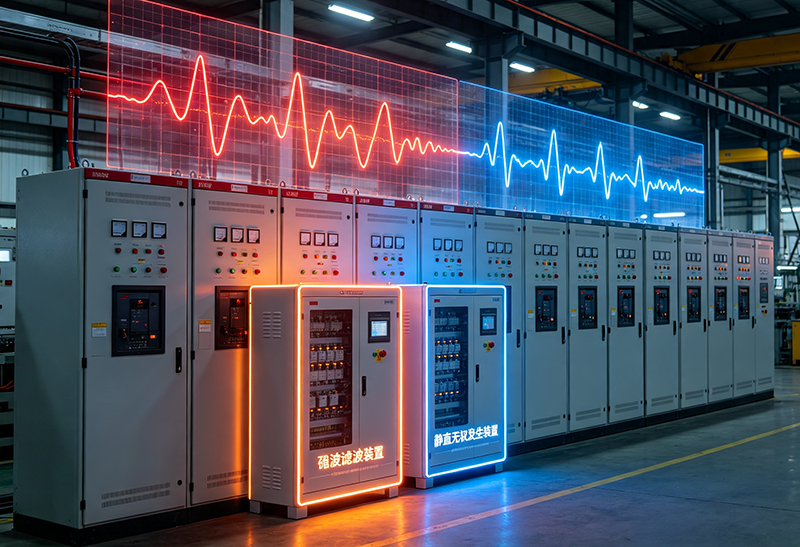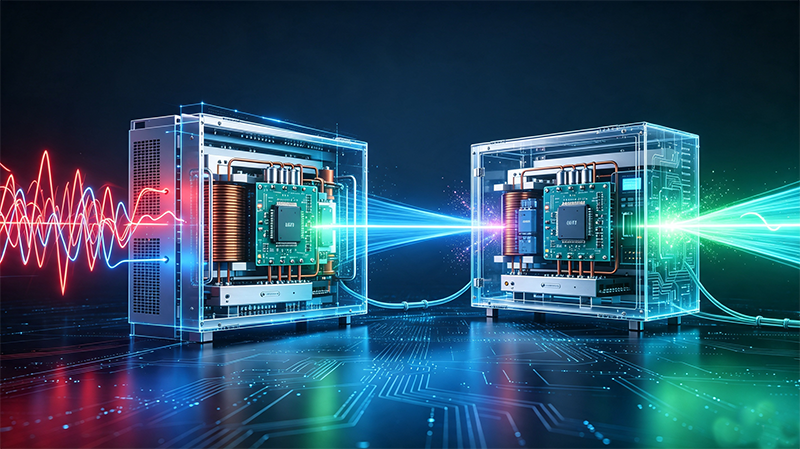
Introduction: Why Power Factor Correction Matters in Data Centers
As a senior electrical engineer at CoEpower, I have spent years designing and optimizing power quality systems for industrial facilities and data centers. One recurring challenge in modern infrastructure is maintaining a stable and efficient power factor (PF) under highly dynamic loads.
Data centers, in particular, are extremely sensitive environments. With the rapid switching of UPS systems, server loads, cooling systems, and power electronics, the reactive power demand fluctuates constantly. Poor power factor leads to:
- Increased electricity bills due to utility penalties
- Higher transformer and cable losses
- Reduced system capacity
- Voltage instability under dynamic load conditions
Traditionally, capacitor banks have been used for power factor correction. However, with the increasing complexity of modern loads, SVG (Static Var Generator) technology is becoming the preferred solution in advanced data centers.
This article provides a deep technical and practical comparison of SVG vs capacitor banks, helping engineers and facility managers make informed decisions.
Understanding Power Factor Correction (PFC)
Power factor is the ratio between real power (kW) and apparent power (kVA). Ideally, this value should be as close to 1.0 as possible.
Most data centers operate with inductive and non-linear loads, which introduce:
- Lagging reactive power (inductive loads like transformers, motors, chillers)
- Harmonic distortion (from UPS systems, rectifiers, servers)
Power factor correction aims to compensate reactive power (kVAR) locally to:
- Improve system efficiency
- Reduce transmission losses
- Free up electrical capacity
- Avoid utility penalties
There are two dominant technologies used today:
- Capacitor Banks
- SVG (Static Var Generator)
What Is a Capacitor Bank?
A capacitor bank is a traditional passive power factor correction system composed of multiple capacitors connected in stages.
How It Works
Capacitor banks provide fixed or stepped reactive power compensation by generating leading reactive power that offsets inductive loads.
Types of Capacitor Banks
- Fixed capacitor banks
- Automatic switched capacitor banks
- Thyristor-switched capacitor banks
Advantages
- Low initial cost
- Simple technology
- Easy installation
- Suitable for stable load conditions
Limitations in Data Centers
However, capacitor banks have significant limitations in modern environments:
- Step-based compensation (not continuous)
- Slow response to load fluctuations
- Risk of overcompensation
- Poor performance under harmonic distortion
- Requires frequent maintenance (contactors, fuses, capacitors aging)
In short, capacitor banks are best suited for stable industrial loads, not dynamic digital infrastructure.
What Is an SVG (Static Var Generator)?
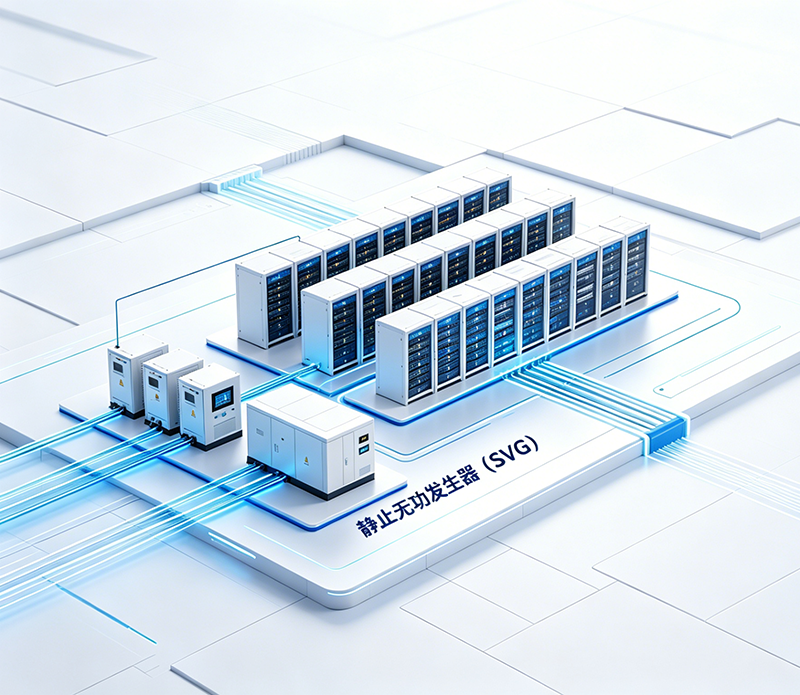
An SVG, or Static Var Generator, is a modern power electronics-based device that provides real-time dynamic reactive power compensation.
Unlike capacitor banks, SVGs use IGBT-based inverter technology to generate or absorb reactive power instantly.
How It Works
- Continuously monitors load current
- Calculates reactive power demand in real time
- Injects compensating current within milliseconds
Key Characteristics
- Fully dynamic compensation (inductive and capacitive)
- Continuous adjustment (not step-based)
- Fast response (typically <10 ms)
- Works well with harmonic distortion
- Compact and modular design
SVG vs Capacitor Bank: Technical Comparison
From an engineering standpoint, the differences are significant.
1. Response Speed
- Capacitor Bank: Slow (seconds-level switching)
- SVG: Ultra-fast (millisecond-level response)
For data centers with fluctuating server loads, SVG clearly outperforms.
2. Compensation Accuracy
- Capacitor Bank: Stepwise, limited precision
- SVG: Continuous and precise compensation
SVG maintains PF close to 0.99 consistently.
3. Harmonic Performance
- Capacitor Bank: Can amplify harmonics (resonance risk)
- SVG: Actively mitigates harmonic distortion
This is critical in UPS-heavy environments.
4. Maintenance Requirements
- Capacitor Bank: Requires capacitor replacement, contactor maintenance
- SVG: Minimal maintenance, solid-state design
5. Space and Scalability
- Capacitor Bank: Bulky, panel-based expansion
- SVG: Compact, modular expansion possible
6. Lifecycle Cost
While capacitor banks have lower upfront cost, SVG offers:
- Lower failure rate
- Reduced downtime risk
- Higher energy efficiency
- Better long-term ROI
Why Data Centers Need SVG More Than Capacitor Banks
Modern data centers are fundamentally different from traditional industrial loads.
1. Highly Dynamic Load Profiles
Server workloads fluctuate within milliseconds due to virtualization and cloud computing.
Capacitor banks cannot react fast enough, leading to:
- Power factor oscillation
- Over/under compensation
SVG solves this with real-time adjustment.
2. Harmonic-Rich Environment
Data centers contain:
- UPS rectifiers
- Switch-mode power supplies
- VFD-driven cooling systems
These create harmonic distortion (3rd, 5th, 7th harmonics).
Capacitor banks may resonate under such conditions, while SVG actively suppresses harmonic currents.
3. High Reliability Requirements
Downtime in data centers is extremely costly. Any instability in power quality can result in:
- Server crashes
- Data loss
- Cooling system imbalance
SVG provides stable, continuous compensation without mechanical switching failures.
4. Energy Efficiency Optimization
Even small improvements in PF (e.g., from 0.92 to 0.99) can significantly reduce:
- Transformer losses
- Cable heating
- Utility penalties
SVG ensures consistently high PF across all load conditions.
Real-World Engineering Insight from CoEpower Projects
In multiple CoEpower data center projects, we observed a consistent pattern:
- Capacitor banks worked well during steady load testing
- But failed to maintain stability during peak cloud traffic changes
After replacing or supplementing with SVG systems:
- Power factor stability improved by 8–15%
- Harmonic distortion reduced significantly
- Maintenance interventions dropped by over 60%
- Overall energy efficiency improved measurably
This demonstrates that SVG is not just an upgrade—it is a system-level improvement in power quality architecture.
Hybrid Solution: SVG + Capacitor Bank
As an engineer, I also recognize that capacitor banks are not obsolete.
In many large installations, a hybrid configuration is optimal:
- Capacitor banks handle base reactive load
- SVG handles dynamic and fast-changing load
Benefits of Hybrid Systems
- Reduced cost compared to full SVG deployment
- Improved system responsiveness
- Lower stress on SVG units
- Balanced lifecycle cost
This approach is especially useful in:
- Tier II / Tier III data centers
- Large industrial campuses
- Mixed-load facilities
How to Choose Between SVG and Capacitor Bank
When designing a power factor correction system, consider the following:
Choose Capacitor Bank if:
- Load is stable and predictable
- Budget is highly constrained
- Harmonic distortion is minimal
- Industrial motors dominate the load
Choose SVG if:
- Load is highly dynamic (data centers, cloud computing)
- Harmonics are significant
- High power quality is required
- Downtime is extremely costly
Choose Hybrid if:
- Large-scale facility with mixed load behavior
- Need balance between CAPEX and performance
Future of Power Factor Correction in Data Centers
The industry is clearly moving toward:
- Full digitalization of power systems
- Real-time energy optimization
- Smart grid integration
- AI-driven load prediction
In this context, SVG technology aligns perfectly with the future of intelligent power infrastructure.
Capacitor banks will still exist, but mainly in supporting roles rather than being the primary solution.
Conclusion
From a senior engineering perspective at CoEpower, the comparison between SVG vs capacitor bank is not just about cost—it is about system behavior under real-world conditions.
Capacitor banks remain a reliable, economical solution for stable loads. However, for modern data centers with dynamic, harmonic-rich environments, SVG (Static Var Generator) provides superior:
- Response speed
- Accuracy
- Harmonic performance
- Reliability
- Lifecycle value
In most modern data center applications, SVG is no longer a luxury—it is becoming a standard requirement for high-performance power quality systems.
If you are designing or upgrading a data center power system, evaluating SVG-based reactive power compensation is a critical step toward achieving higher efficiency, stability, and long-term operational reliability.
Keyword Tags
Power factor correction, SVG vs capacitor bank, Static Var Generator, capacitor bank system, data center power quality, reactive power compensation, harmonics mitigation, industrial power factor correction, dynamic VAR compensation, CoEpower engineering solutions, suppliers, manufacturers, factory, company, China, wholesale, buy, price, quotation, bulk, for sale, companies, stock, cost.